

- Concerns
When It’s All Too Much: Understanding Stress, Overwhelm and Anxiety

Decoding Your Body’s Signals So You Know How To Respond
You know the feeling.
You’ve taken the weekend off. You cancelled plans. Maybe you napped. Maybe you journaled. Maybe you did absolutely nothing.
And yet… Monday comes, and your chest still feels tight. You’re short-tempered with your partner. You stare at your inbox like it’s a wall you can’t climb. You’re more tired than before, somehow.
It’s the kind of burnout that sleep doesn’t fix. The kind of “too much” that weekends and vacations can’s seem to undo.
This is something we hear all the time in therapy. People are doing what they’ve been told to do: rest, unplug, take care of themselves. But the relief doesn’t land. Why?
Because stress, overwhelm and anxiety are not created equal.
And without knowing which it is, it’s hard to know what kind of care your system actually needs.
In therapy, we often start by mapping the internal landscape: learning to name what’s happening in your nervous system. And when you can tell the difference between stress, overwhelm, and anxiety, you unlock the ability to respond with real support instead of just pushing through.
There is a crucial difference between these states. Each one arises from different mechanisms in the body and brain. And each one asks something different from us in order to heal.
What’s In A Name? Stress, Overwhelm and Anxiety
Stress: The Perceived Pressure
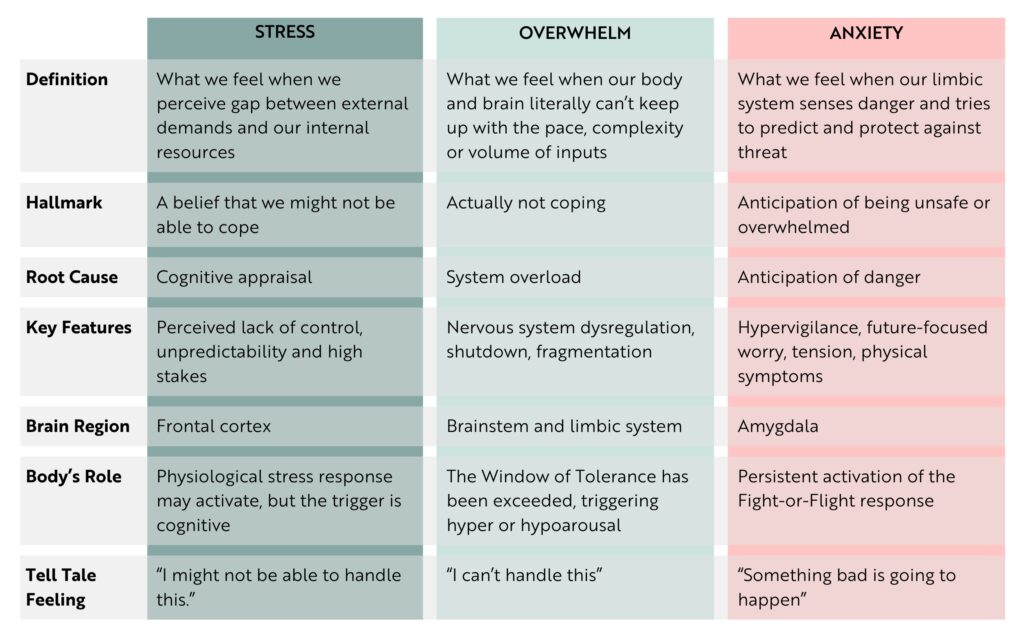
Stress is the body’s response to a demand that feels just slightly out of reach. It arises when we evaluate the demands of a situation as greater than our perceived capacity to manage it. In psychological terms, it’s a cognitive appraisal problem: we think we might not be able to cope.
Common characteristics of stress:
-
-
-
- Feeling tense or wound up
- Racing thoughts
- Trouble sleeping
- Irritability or frustration
- Physiological changes like a racing heart, shallow breathing, or muscle tension
-
-
Stress is about your brain believing you might not cope. It’s tied to what you think.
Overwhelm: The System Overload
Where stress is a mental appraisal, overwhelm is a physiological state. It happens when your nervous system is flooded; when the speed, complexity, or emotional intensity of life exceeds your ability to process it. It’s not that you’re thinkingyou can’t cope anymore. It’s that your system actually can’t.
Overwhelm is often the result of being outside your Window of Tolerance — the zone in which your nervous system can function optimally. When we leave this window, we may swing into hyperarousal (agitation, anxiety, chaos) or hypoarousal (numbness, disconnection, freeze).
Common signs of overwhelm:
-
-
-
- Emotional flooding or inability to regulate emotion
- Feeling frozen, shut down, or numb
- Dissociation or zoning out
- Everything feels urgent, but you can’t prioritize
- Sensory overload
-
-
Overwhelm is your body’s way of saying “too much.” It often means your system has been trying to cope with chronic stress for too long and has run out of bandwidth.
Overwhelm is about your nervous system sensing that it’s overloaded. It’s tied to how your system is actually functioning
Anxiety: The Anticipatory Alarm
Anxiety, while related, is distinct from both stress and overwhelm. It’s the nervous system’s way of scanning for danger, whether or not a threat is actually present.
Anxiety is rooted in the brain’s fear circuits, particularly the amygdala, which governs threat detection. This system doesn’t wait for evidence. It reacts to the possibility of harm.
Whereas stress and overwhelm are often tied to specific events or loads, anxiety can feel more diffuse, like a looming sense of dread.
Common features of anxiety:
-
-
-
- Persistent worry, often without a clear cause
- Restlessness or inability to relax
- Physical symptoms: stomach upset, rapid heartbeat, muscle tension
- Difficulty concentrating
- Sleep disruption
-
-
Anxiety often follows on the heels of chronic stress or unresolved overwhelm. It becomes a kind of background operating system: scanning for problems, predicting catastrophe, trying to stay ahead of danger.
Anxiety is about preparing for danger. It’s tied to your limbic system’s perception of threat.
Where Am I On The Spectrum?
If you’re not sure what you’re experiencing, that’s okay. Many people fluctuate between these states throughout the day. But having a framework can help you respond in the right way.
Here are a few prompts to help you identify your state:
-
-
-
- Are your thoughts racing about a specific task or situation? You may be stressed.
- Do you feel like you can’t prioritize, or that everything feels like too much? You may be overwhelmed.
- Are you scanning for what might go wrong, unable to relax, even when things are fine? That’s likely anxiety.
- Does your body feel heavy, numb, or shut down? You may be in a hypoaroused state of overwhelm.
- Are you emotionally reactive, or constantly on edge? That could be anxiety or the hyperaroused state of overwhelm.
-
-
Understanding where you are helps you know what kind of care you need.
Matching The Response To The State
Different states require different tools. What soothes stress may not touch anxiety. What helps anxiety might exacerbate overwhelm.
If you’re stressed: Focus on cognitive tools and boundary-setting.
-
-
-
- Time blocking or prioritizing tasks
- Naming your stressors and challenging catastrophic thoughts
- Physical activity to burn off excess cortisol
- Creating margin: fewer decisions, more routines
-
-
If you’re overwhelmed: Focus on regulation and slowing down.
-
-
-
- Orient to your physical environment (look, listen, feel)
- Engage in sensory self-soothing: warm tea, soft textures, gentle movement
- Limit input (phone off, notifications off, reduce noise/light)
- Short, nourishing tasks (folding laundry, watering plants)
-
-
If you’re anxious: Focus on safety and reconnection.
-
-
-
- Deep, diaphragmatic breathing
- Grounding exercises (5-4-3-2-1 senses check-in)
- Co-regulation with a trusted person or pet
- Externalizing the anxious voice: write it down, talk back
- Gentle movement that discharges energy (walking, stretching)
-
-
The goal here isn’t (at first) to feel amazing. The goal is to bring your system back to its window of tolerance, where you can think, feel, and act clearly.
You’re Not Broken, You’re Just Maxed Out
When we can name what’s happening in our nervous system, confusion turns to compassion.
You’re not lazy. You’re not weak. You’re not failing to rest.
You may be overwhelmed. And what you need might not be more effort. It might be more attunement.
This is the work of therapy. Not just talking through problems, but learning to understand your system, widen your window of tolerance, and build new tools that meet you where you are, not where you think you should be.
If any of this feels familiar, you’re not alone. And you don’t have to figure it out on your own.
Together, there’s a way forward.
Get Matched with a Therapist.
Because finding support should never be as hard as what you’re going through.