

- Therapies
Polyvagal Theory and Somatic Healing: Understanding Your Nervous System in Richmond Hill
Have you ever felt like your body was reacting to something before your mind even had a chance to process it? Maybe it’s a sudden racing heart when you walk into a crowded room on Yonge Street, or perhaps a heavy, “numb” feeling that washes over you during a stressful day at work.
In Richmond Hill, many of us live high-paced lives, and our nervous systems often bear the brunt of that pressure. Traditional “talk therapy” is a wonderful tool, but sometimes, you can’t simply think your way out of a feeling. That is where Polyvagal Theory and Somatic Healing come in. At Inner Summits, we look at the “old code” your body is running and help you update it for a life of greater freedom and ease.
What Is Polyvagal Theory and Why Does It Matter?
Polyvagal Theory, developed by Dr. Stephen Porges, is essentially a roadmap for your nervous system. It explains how our bodies automatically scan our environment for cues of safety or danger—a process called “neuroception.”
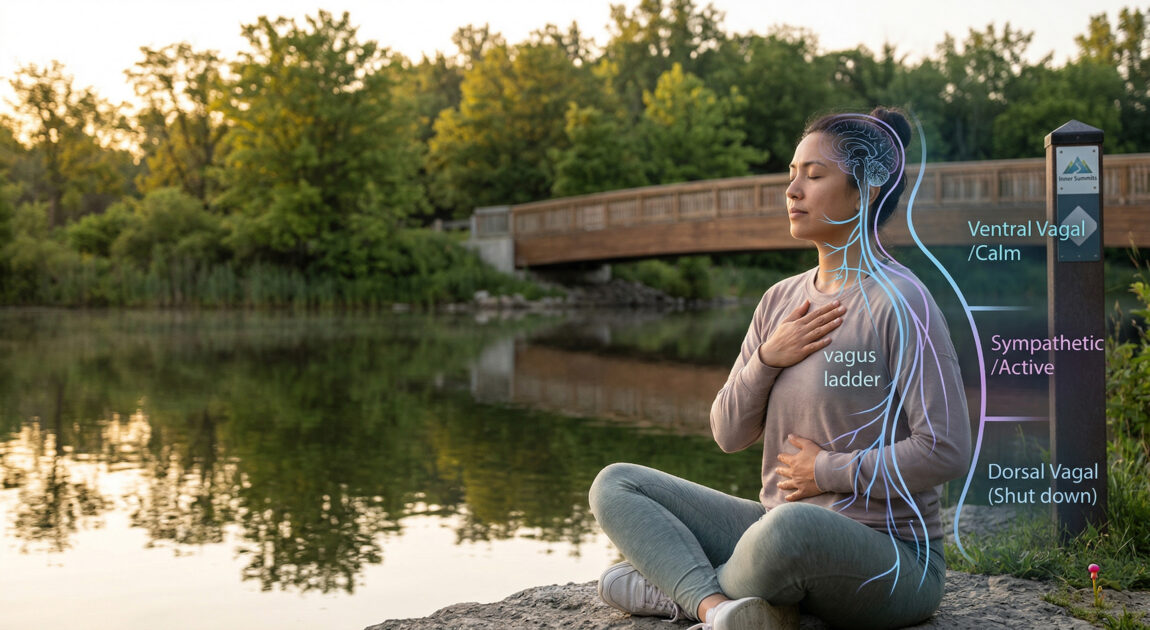
Instead of a simple “on/off” switch for stress, this theory introduces us to a “ladder” of three primary states:
- The Ventral Vagal State (Safety & Connection): This is the top of the ladder. Here, you feel calm, social, and capable of handling life’s challenges.
- The Sympathetic State (Fight or Flight): The middle rung. This is mobilization. Your heart rate increases, and you feel anxious or frustrated.
- The Dorsal Vagal State (Freeze or Shutdown): The bottom rung. This is immobilization. You might feel “checked out,” depressed, or physically heavy.
Understanding this theory matters because it takes the shame out of your reactions. You aren’t “weak” or “broken”; your nervous system is simply doing its job to protect you based on its current map of the world.
How Does Somatic Healing Help You Move Up the Ladder?
If Polyvagal Theory is the map, Somatic Healing is the vehicle. Somatic therapy is a “bottom-up” approach. While traditional therapy often starts with the mind (top-down), somatic work starts with the body.
By focusing on physical sensations—the “felt sense”—you can begin to release stored tension and trauma that your mind might have forgotten, but your body remembers. At Inner Summits, we use these techniques to help you recognize which rung of the ladder you are on and give you the tools to climb back up to a state of safety and connection.
Why Is a “Bottom-Up” Approach Better for Trauma?
When we experience trauma, the logical part of our brain (the prefrontal cortex) often goes offline. This is why you might know intellectually that you are safe, but your body still feels like it’s in a state of emergency.
- Bypassing the Loop: Bottom-up approaches like Somatic Experiencing or EMDR target the deeper, survival-based layers of the brain.
- Targeting the Root: Instead of just managing symptoms, we look for the “old code” or root causes stored in the nervous system.
- Experiential Learning: You don’t just talk about being calm; you actually experience the physiological shift toward calm in the session.
What Should You Expect During a Somatic Session at Inner Summits?
Many people are nervous about starting therapy because they don’t want to be “re-traumatized” by retelling their stories. Our approach is different. We focus on:
- The Warm-Up: Restoring your capacity and creating a “map” of your experiences so things feel less chaotic.
- Regulation Skills: Learning practical ways to soothe your system, such as mindful breathing or grounding exercises.
- The Journey: Gently repairing and releasing the burdens you’ve carried, ensuring the process is paced exactly for your system.
- The Summit: Reclaiming the authentic you that exists beneath the old patterns of protection.
Can Somatic Healing Improve Your Daily Life in Richmond Hill?
Living in a suburban-urban hub like Richmond Hill presents unique stressors—traffic, professional competition, and the juggle of family life. Somatic healing provides a buffer against these pressures by:
- Increasing Resilience: You learn to shift between nervous system states without getting “stuck.”
- Improving Relationships: Through “co-regulation,” you learn how to stay present and connected with loved ones, even during conflict.
- Physical Relief: Many clients find that addressing the nervous system helps reduce chronic pain, digestive issues, and fatigue.
Is This Approach Effective for Anxiety and Depression?
Yes. Anxiety is often a sign of a nervous system stuck in a “Sympathetic” (fight/flight) state. Depression is often a sign of a system that has collapsed into a “Dorsal Vagal” (freeze) state to protect itself from overwhelming stress.
By identifying these biological patterns, we can use specific interventions:
- For Anxiety: Using grounding and “discharge” techniques to settle the high energy of the sympathetic system.
- For Depression: Gently “inviting” the system back into mobilization and connection without overwhelming it.
How Does Inner Summits Differ from Traditional Clinics?
At Inner Summits, we believe therapy doesn’t need to be a mystery. We provide a transparent roadmap and use evidence-based, neurobiological methods. We aren’t here to offer “band-aid” solutions. We specialize in:
- EMDR (Eye Movement Desensitization and Reprocessing)
- Internal Family Systems (IFS)
- Somatic Psychotherapy
- Neurofeedback
We view the mind as a computer that sometimes needs a software update. We help you uninstall the “old code” that leads to triggers and install a new way of being that feels light and free.
Conclusion: Reclaim Your Summit
Your nervous system is an incredible, adaptive system designed to keep you safe. However, if you’ve been stuck in survival mode for too long, it’s time for a change. You don’t have to navigate the peaks and valleys of your life alone.
At Inner Summits in Richmond Hill, we are dedicated to helping you understand your body’s signals and move toward a life of genuine connection and peace. Whether you are dealing with trauma, chronic stress, or simply feel “off,” there is a path forward.
Ready to start your journey?
Contact Inner Summits today for a free consultation. Let’s map out your path to healing together.
Frequently Asked Questions (FAQ)
1. What is the “Vagus Nerve” and why is it important?
The Vagus Nerve is the longest nerve in your Autonomic Nervous System. It acts as a two-way communication highway between your brain and your vital organs. It is crucial because it is the primary component of the “Social Engagement System,” helping you relax, digest food, and connect with others.
2. I’ve tried talk therapy before; how is somatic therapy different?
Talk therapy focuses on the “what” and the “why” of your thoughts. Somatic therapy focuses on the “how” of your body’s reactions. By addressing the physical sensations of stress and trauma, we can often reach resolutions that talking alone cannot achieve.
3. Do I have to talk about my trauma in detail?
Not necessarily. In somatic and neurobiological-based therapies, the focus is often on the physiological impact of the memory rather than the narrative details. We work to ensure you stay within your “window of tolerance” so you feel safe throughout the process.
4. How long does it take to see results?
Every nervous system is different. However, many clients begin to feel a shift in their baseline level of calm within the first few sessions as they learn regulation skills. Lasting “re-programming” of the nervous system is a journey that we pace according to your needs.
5. Is this only for people with PTSD?
No. While these methods are gold-standard for PTSD, they are also highly effective for anyone experiencing chronic stress, “burnout,” anxiety, or relationship difficulties. If you feel “stuck” in any area of your life, your nervous system likely has a role in it.
Get Matched with a Therapist.
Because finding support should never be as hard as what you’re going through.