

Sound Bath Therapy in Vaughan, Richmond Hill & Toronto

Healing – beyond words.
There are moments when your body holds experiences more than your mind can explain. When tension lingers without reason, and emotions live just below the surface, waiting for permission to move.
Sound Bath therapy offers that permission—not through analysis or explanation, but through vibration, resonance, and felt experience. It speaks to the parts of you that don’t need fixing—just listening.
At Inner Summits, we use sound to help the nervous system remember what safety feels like. Gently. Deeply. Without words.
What Is Sound Bath Meditation?
A sound bath is an immersive, full-body experience in which sound becomes your guide. You’re not here to perform or strive—you’re here to receive.
Lying down in a calm and quiet setting, you’re surrounded by tones from instruments such as crystal singing bowls, Himalayan bowls, gongs, chimes, and sometimes the human voice. These sounds move around and through the body, like waves washing over shoreline—sometimes subtle, sometimes deep and thunderous.
These tones are not designed to entertain the thinking brain. The practice is called a “bath” because the sound waves wash over you, creating a sensory landscape that quiets the mind and helps regulate the body. What makes it therapeutic is not just the sound—but how your nervous system responds to it.
They’re crafted to reach the emotional brain and restore nervous system balance.
When talking feels too much… and silence doesn’t feel enough… sound offers another way through.
How Sound Bath Works: A Bottom-Up Perspective
From a neuroscience and somatic therapy perspective, sound therapy is powerful because it works directly with the parts of the brain and body that hold emotional memory.
-
The Body’s First Language Is Sound
Long before we spoke a word, we responded to sound. The rhythm of a lullaby. The softness of a caregiver’s voice. The pulse of a heartbeat. The muffled sounds of the womb. These are our earliest forms of contact with the outside world.
From birth, our bodies learn what safety sounds like in the same way they learn what danger sounds like. In fact, trauma, stress, and fear imprint through sound as much as sight or touch. Sound therapy uses this same pathway to guide the nervous system back into coherence.
-
Stress & Trauma Lives Where Words Cannot Reach
When we experience chronic stress or trauma, the parts of the brain responsible for language and logic often go offline. What remains is the body’s memory—stored in the amygdala, brainstem, and vagal nerve pathways.
These systems can’t heal through verbal dialogue or rational thinking—and therefore often untouched by traditional talk therapy. Sound therapy however speaks directly to these deeper systems, helping to access and release what the body has been holding—without requiring you to relive the story.
-
Sound Alters Brainwaves
The brain is an “electrical machine”. It pulses in rhythmic waves (called brainwaves) that correspond to our state of consciousness—alertness, stress, dreaming, rest. Neuroscience research has shown that different sound frequencies can influence our brainwave configuration and consequently changing our state of consciousness. Basically, our brain can go from anxious to calm or vice versa simply by listening to specific sound frequencies. That’s why, during a sound healing session, the therapeutic tones are intended to gradually shift brainwave activity:
-
-
- From beta (anxious, busy)
- To alpha (calm focus)
- To theta (dreamlike, emotionally intuitive)
- And even to delta (deep restoration and healing)
-
These shifts allow the body to rest, process, and integrate experiences that may otherwise remain stuck or unspoken. Read our blog on the neuroscience of sound therapy to learn more!
Benefits of Sound Therapy For Anxiety & Sleep
Sound therapy offers far more than relaxation—it’s a bottom-up regulation-based approach rooted in both ancient wisdom and modern science. Current research suggests that specific therapeutic frequencies may:
-
-
- Reduce cortisol (the primary stress hormone)
- Improve vagal tone, a measure of nervous system flexibility and resilience
- Increase heart rate variability, a marker of the body’s capacity to adapt and recover
- Activate theta waves, which support deep emotional insight and meditative states
-
When sound calms the nervous system, the thinking brain often follows. Symptoms of anxiety or hyperarousal lower and sleep improves. In that stillness, the body also begins to feel safe enough to process what it previously had to hold.
Because sometimes healing begins with a single vibration.
What to Expect in a Sound Therapy Session
You don’t need to know how to meditate, like or understand music. You don’t need to perform, fix, or achieve anything. Sound therapy is not something to master—it’s something to experience. All you need is a willingness to show up and receive.
Before the Session
You’ll be welcomed into a quiet, calming space—whether in person or online. We provide mats, cushions, blankets, and eye masks to help your body settle. The session begins with a brief check-in or grounding exercise, allowing you to set an intention or simply notice how you’re arriving.
During the Session
The practitioner introduces sound slowly—layers of bowls, gongs, chimes, and overtone instruments begin to fill the room and your body with vibration. These sounds don’t follow a melody or beat. Instead, they create an unfolding soundscape that invites stillness, insight, and release. You may notice:
-
-
- A sense of floating or heaviness
- Physical sensations like tingling or warmth
- Emotional waves—joy, sadness, calm, grief
- A shift in your awareness, similar to dreaming or deep meditation
-
Some people cry. Some fall asleep. Some simply breathe more deeply than they have in weeks. All of it is welcome.
After the Session
As the sounds soften, silence returns. This is often where integration begins. You’ll have time to sit up slowly, hydrate, and reflect—either in quiet or with gentle guidance. It’s common to feel tender, peaceful, or slightly disoriented as your system recalibrates. This is part of the process. Your sound bath therapist may suggest somatic practices or space for stillness afterward, depending on what emerged for you.
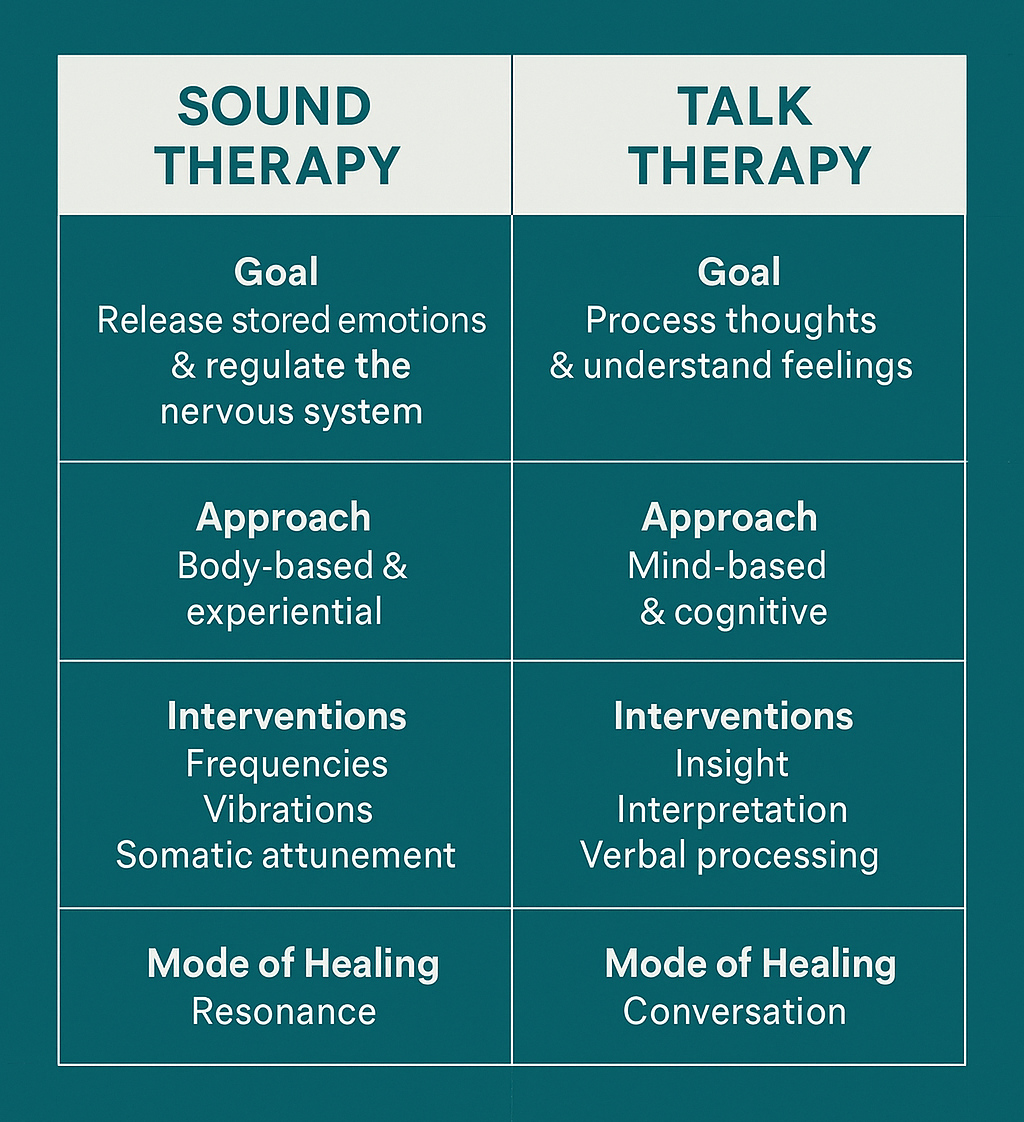
Sound Bath Therapy for Emotional Healing vs. Talk Therapy
If traditional talk therapy feels stuck in storytelling, sound therapy may offer a new way forward—one that speaks the body’s language.
Is Sound Therapy Right for Me?
Sound therapy can be especially supportive if:
-
-
- You feel stuck, numb, or emotionally distant
- You’ve found talk therapy helpful—but incomplete
- You’re processing trauma, grief, anxiety, or burnout
- You long to feel connected to your body again
- You’re curious about experiential, body-based healing
- You sense there’s something inside that’s ready to move—but doesn’t know how
-
Healing doesn’t always start with a story. Sometimes, it starts with a sound sensation. When words are no longer helpful, sound can become your inner co-therapist.
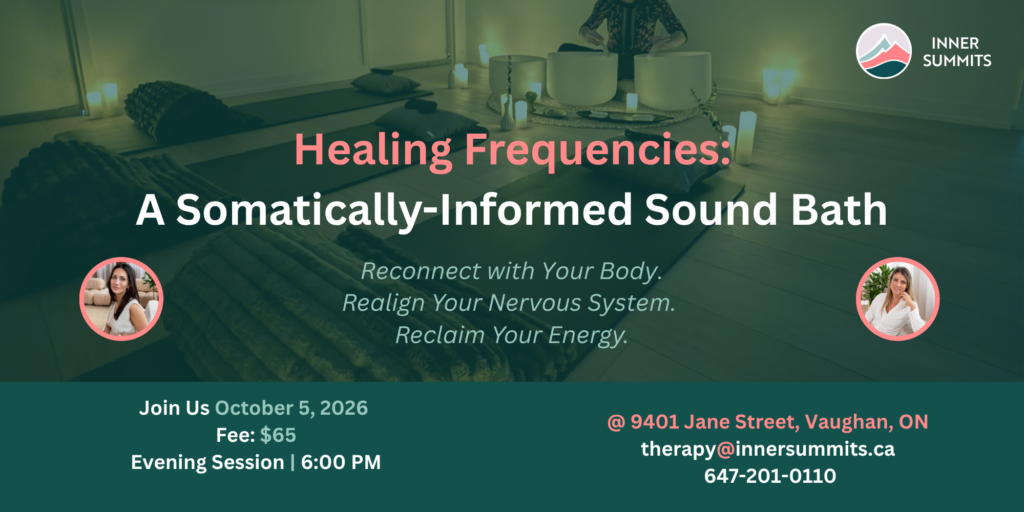
Upcoming Somatic Sound Therapy Session
Our team includes therapists and facilitators trained in trauma-informed sound healing, music therapy, somatic therapy, IFS, EMDR, and more. Whether you’re seeking a one-time immersive experience or want to integrate sound into your ongoing therapeutic work, we’re here to walk with you—attuned, grounded, and guided by both science and heart.
Get Matched with a Therapist.
Because finding support should never be as hard as what you’re going through.